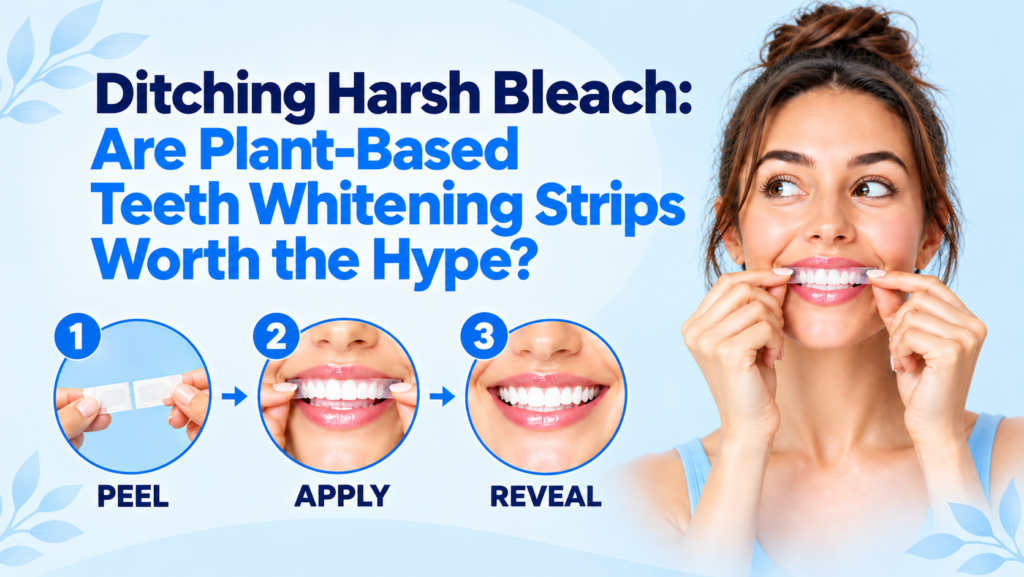
You want a brighter smile, but you may not want the sensitivity associated with stronger whitening treatments. That is where plant-based teeth whitening strips come in. They offer an at-home option for gradually tackling everyday stains.
But does “plant-based” actually mean effective whitening? Or is it simply another label designed to sell the product?
The answer lies in the formula. Your staining, sensitivity, expectations, and treatment routine are important as well. For regular coffee drinkers, long-term maintenance matters just as much as the first whitening course.
What Are Plant-Based Teeth Whitening Strips?
What Makes a Whitening Strip “Plant-Based”?
Whitening strips are thin films placed against your teeth. They deliver a whitening formulation directly to the tooth surface during treatment.
“Plant-based” is not a standard clinical category. It generally describes products containing plant-derived or naturally sourced ingredients.
That label does not automatically mean peroxide-free. It also does not guarantee zero irritation or better whitening.
You should check the complete ingredient list instead of relying on the front of the packaging. EverBlanc uses a non-peroxide whitening formula containing ingredients such as sage oil and lemon fruit oil.
Natural Ingredients vs. Actual Whitening Actives
There is an important difference between reducing surface stains and changing the colour of the tooth itself.
Coffee, tea, red wine, and smoking can cause extrinsic stains. These develop on the outside of the teeth. A whitening product may target these stains without drastically changing your natural tooth shade.
This is why “natural” should not be your only buying criterion. The actual formula and expected result are much more important.
Do Plant-Based Whitening Strips Actually Work?
Plant-based teeth whitening strips can help with certain stains, but results depend on the formulation and type of discolouration.
Extrinsic stains from coffee and tea are generally more suitable for surface-focused whitening. Intrinsic discolouration develops within the tooth and needs professional assessment.
This creates an important difference from professional teeth whitening.
Peroxide-based bleaching has stronger evidence for changing tooth colour. Professional treatment also lets a dentist assess whether whitening suits your teeth.
Non-peroxide does not mean ineffective. Research into a non-hydrogen-peroxide products has found measurable whitening from some formulations. Results varied significantly between products, however.
What’s the Difference Between Plant-Based & Traditional Whitening Strips?
| Factor | Plant-Based/ Non-Peroxide Strips | Traditional Whitening Strips |
| Main approach | Uses alternative whitening ingredients | Commonly uses peroxide-based bleaching |
| Sensitivity | Designed to avoid peroxide-related sensitivity | Temporary sensitivity can occur |
| Whitening results | Usually focused on gradual stain reduction | Stronger bleaching effect is established |
| Ingredient preference | Suits buyers seeking plant-derived ingredients | Suits buyers comfortable with conventional actives |
| Best fit | Everyday surface stains and gradual whitening | Greater colour change when appropriate |
The choice is not really “natural versus chemical”. It is about the formulation and the result you expect.
What Should You Look for Before Buying?
Check the Ingredients and Claims
Start with the ingredient list. Look for a clearly stated whitening system and specific application instructions.
Be cautious with vague promises such as “detox” or “instant transformation”. A credible product should explain what the treatment is designed to achieve.
Treatment frequency matters too. More frequent use does not automatically mean faster or better whitening.
Think About Sensitivity and Existing Dental Work
Peroxide whitening can cause temporary sensitivity in some people. A non-peroxide option may appeal if sensitivity is a concern.
That does not mean every non-peroxide product guarantees a sensitivity-free experience. Individual responses still vary.
Existing dental work needs another consideration. Whitening changes natural tooth colour, but it does not whiten veneers or crowns. If you have untreated dental problems, speak with your dentist before whitening.
Why Choose EverBlanc Teeth Whitening Strips?
EverBlanc is designed for people seeking gradual, non-peroxide teeth whitening at home.
Its current strips target everyday surface stains associated with coffee, tea, food, and lifestyle habits. The recommended treatment involves applying the strips for 30 minutes once daily.
That format suits people who want whitening to fit around their existing routine. You apply the strips, complete the treatment, and continue with normal daily life.
The product is also available through treatment programmes. The Starter Ritual contains 14 treatments, while the complete ritual includes 21. This matters for regular coffee drinkers.
Your morning coffee does not stop staining your teeth after a whitening course. Maintaining a brighter-looking smile requires attention to the habits that cause surface staining.
EverBlanc’s gradual approach therefore fits a maintenance mindset. It is less about chasing a dramatic overnight change and more about managing everyday staining consistently.
Are Plant-Based Whitening Strips Worth Buying?
They can make sense if you want:
- A non-peroxide whitening approach
- Gradual whitening rather than intensive bleaching
- An at-home treatment
- Support for everyday coffee and tea stains
- A routine that fits longer-term smile maintenance
- An alternative to peroxide-based whitening
If dramatic shade changes are your priority, peroxide whitening has stronger evidence behind it. Dentist-prescribed teeth whitening may also be appropriate after a dentist assesses your teeth.
If you are researching professional teeth whitening strips in UK alternatives, compare the formula, treatment schedule, and expected results. Do not assume every whitening strip delivers the same outcome.
In Summary
“Plant-based” can be a genuine ingredient preference. It should not replace checking what the product actually does. Think about your staining first. Surface coffee stains create a different whitening goal from deeper tooth discolouration. Your sensitivity concerns matter too. So does the level of whitening you expect.
If you want gradual, non-peroxide whitening at home, EverBlanc Teeth Whitening Strips are worth considering. Our treatment format also supports ongoing maintenance when everyday habits continue creating surface stains.
FAQs
Are plant-based teeth whitening strips safe?
Safety depends on the formulation and correct use. Follow the product instructions carefully and consult a dentist about existing dental concerns.
Can they remove coffee and tea stains?
They can help target extrinsic stains on the tooth surface. Regular coffee drinkers may also use whitening as part of ongoing maintenance.
Are plant-based strips better for sensitive teeth?
Not automatically. Non-peroxide formulas avoid peroxide, but individual sensitivity still varies between people and products.
How often should you use whitening strips?
Follow the individual product’s instructions. EverBlanc currently recommends 30-minute applications once daily during its treatment course.
Do whitening strips work on veneers?
Whitening strips affect natural tooth colour. They do not change the colour of veneers, crowns, fillings, or similar restorations.