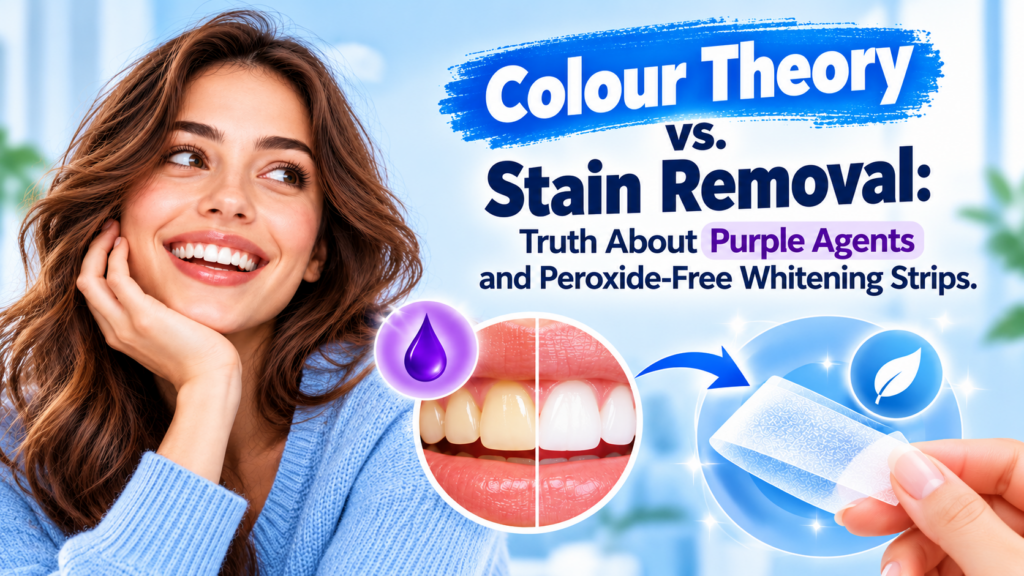
Purple whitening products can make your teeth look whiter right away, but they don’t remove any stains. They work like purple shampoo on blonde hair: purple sits opposite yellow on the colour wheel, so a hint of violet hides the yellow. It covers the colour, it doesn’t clean it.
Regular whitening strips remove stains using peroxide. But peroxide-free whitening strips claim they can whiten your teeth without any of these chemicals. So, the real question is what really works.
Below, we discuss what purple products really do, how peroxide-free strips compare, and whether either is worth buying.
How Colour Theory Makes Teeth Look Whiter
Purple Neutralises Yellow Tones Visually
Think about the colour wheel. Purple sits opposite yellow, so a purple tint can make yellow tones appear less noticeable when the two colours are placed together.
That is the basic idea behind purple colour correction for teeth. It changes the appearance of the tooth shade rather than necessarily removing the cause of the discolouration. It’s a visual effect, not automatically the same chemical process used in conventional tooth bleaching.
Why the Effect Can Look Immediate But Temporary
A colour-correcting product can appear to work quickly because the purple pigment changes how the tooth colour is perceived.
The catch is that this doesn’t necessarily mean an existing coffee or tea stain has been removed. Once the colour-correcting effect fades, the original shade can become noticeable again.
That makes purple products more relevant if you want a quick visual change. If you want to address staining over time, you need to look at the ingredients and the whitening method rather than the colour of the product.
A 2025 systematic review about hydrogen peroxide-free colour correctors examined peroxide-free products and found measurable changes in tooth colour across the products studied. It identified six relevant studies, including one clinical trial and five laboratory studies, and reported measurable colour changes.
However, the researchers also noted the limited amount of clinical evidence and differences between the products studied. That means the findings should not be treated as proof that every purple whitening product works in the same way.
Purple Whitening vs. Actual Stain Removal
What Purple Agents Can and Cannot Do
Purple agents mainly change how yellow tones look. They should not automatically be described as stain removers.
Surface stains can develop from things such as coffee and tea. Other changes in tooth colour happen within the tooth itself, so different types of discolouration may respond differently to different whitening methods.
The American Dental Association’s guidance on tooth whitening explains that whitening products can address certain types of discolouration but do not change the colour of tooth-coloured restorations in the same way as natural teeth. That distinction is important when you’re deciding what results you can realistically expect.
A purple product making teeth look whiter therefore does not necessarily mean it has removed the stain responsible for the original colour.
Where Peroxide-Free Whitening Strips Fit In
This is where peroxide-free whitening strips become a different proposition.
“Peroxide-free” simply means the formula does not use hydrogen peroxide or carbamide peroxide as its whitening ingredients. It does not tell you exactly how the product works or guarantee a particular result.
Different peroxide-free products can use different ingredients and mechanisms. Some may focus on colour correction, while others are designed to address surface staining through a different active ingredient.
EverBlanc takes a non-peroxide approach and is positioned around gradual, sensitive teeth whitening rather than an instant colour change. If you are a coffee lover and don’t want to stop your daily dose of caffeine, this approach can make more sense than relying on temporary colour correction.
Peroxide-Free Does Not Mean “No Whitening Action”
Check the Active Ingredients, Not Just the Front Label
The front of a packet tells you what the manufacturer wants you to notice. The ingredient list tells you more about what you are actually buying.
Look at the named active ingredients for use. Then consider what the manufacturer says those ingredients are intended to do.
Who Is Most Likely to Notice a Difference?
People who have yellow-toned teeth or have surface stains notice results faster than those with deeper discolouration. For regular coffee drinkers, keeping a bright smile requires consistent maintenance rather than a single treatment.
EverBlanc offers gradual whitening, ideal for daily routine use, which also works for enamel-safe teeth whitening through a non-peroxide formula that avoids traditional whitening sensitivity.
Dental restorations are different. Crowns, veneers and fillings do not whiten in the same way as natural teeth. The American Dental Association’s whitening guidance specifically notes that tooth-coloured restorations are not changed by whitening treatments in the same way as natural tooth structure.
What Should You Buy: Purple Whitening or Whitening Strips?
Choose Purple Agents If You Want a Quick Visual Boost
Purple colour correction makes sense if your main priority is an immediately brighter-looking smile.
It can be useful when yellow tones are your main concern, and you want to change their appearance quickly. The trade-off is simple: colour correction can change how teeth look without necessarily addressing the stain behind that colour.
If you want a temporary visual lift before an event or occasion, that may be exactly what you need.
Choose Peroxide-Free Whitening Strips If You Want More Than Colour Correction
To achieve more than temporary visual brightening, review the complete product formula. EverBlanc offers a peroxide-free, non-sensitive formula tailored for gradual whitening rather than rapid results, making it ideal for those seeking a gentler routine.
This gradual approach helps coffee drinkers maintain their smile over time by targeting surface stain accumulation without requiring them to give up coffee. Ultimately, focus on the formula’s intended function and your specific goals rather than relying solely on marketing labels like “purple” or “peroxide-free”.
5 Things to Check Before Buying Whitening Strips
Active ingredients: Know what is responsible for the product’s whitening or colour-correcting action.
Type of discolouration: Surface stains from coffee and tea are different from changes in the natural colour of the tooth.
Sensitivity instructions: Check the recommended wear time and frequency. More frequent use does not automatically mean faster or better whitening.
Dental restorations: Crowns, veneers and fillings do not whiten in the same way as natural teeth.
Long-term maintenance: If you drink coffee regularly, consider whether the product fits your normal routine. EverBlanc’s gradual approach is designed around ongoing whitening and maintenance rather than a one-off visual effect.
Concluding Words
Purple colour correction and whitening strips are not automatically doing the same job. Purple pigments can make yellow tones appear less noticeable, while a whitening product may be designed to address surface staining over time.
If you’re looking for good whitening strips in UK, start with the formula and the result you want. If you mainly want quick colour correction, purple agents may suit you. If you want gradual, non-peroxide whitening that can fit around habits such as drinking coffee, EverBlanc offers a different approach.
For people concerned about sensitivity, EverBlanc’s peroxide-free whitening strips positioning may also be worth considering. As with any whitening product, follow the product instructions rather than assuming that longer or more frequent use will produce better results.
FAQs
Do purple whitening products actually remove stains?
Not necessarily. Purple products mainly change how yellow tones appear. That visual correction is different from removing the surface stain responsible for the discolouration.
Are peroxide-free whitening strips effective?
They can be, but “peroxide-free” alone does not tell you how effective a product will be. A 2025 systematic review found measurable colour changes with some hydrogen-peroxide-free colour-correcting products, but it included only six relevant studies and did not establish that all peroxide-free products work in the same way.
Can purple whitening products whiten crowns or veneers?
No whitening product should be expected to change crowns or veneers in the same way as natural teeth. The American Dental Association’s whitening guidance explains that tooth-coloured restorations do not respond to whitening treatments in the same way as natural teeth.