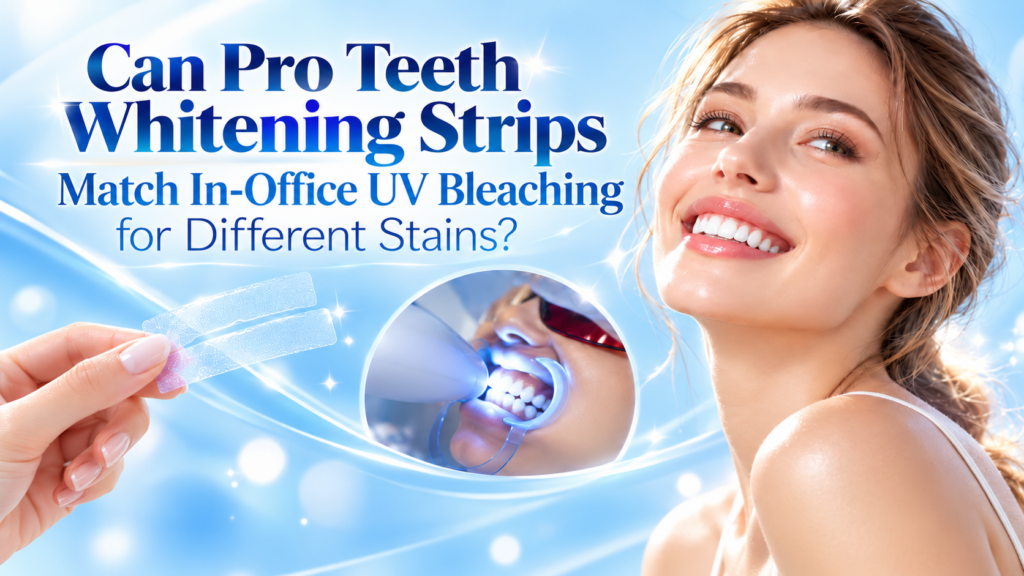
Coffee stains, yellowing, and uneven tooth colour can make choosing a whitening treatment very difficult. Pro teeth whitening strips offer a convenient home option, while in-office UV bleaching promises a professionally managed treatment.
But paying more or choosing a product with a stronger-sounding name doesn’t automatically mean better results. The bigger question is what caused your discolouration in the first place. Surface stains. Age-related yellowing and deeper internal stains can respond differently to whitening.
Understanding those differences helps you choose a treatment that suits your teeth, budget, and sensitivity concerns.
Table of Contents
How Do Pro Teeth Whitening Strips and UV Bleaching Work?
Professional Whitening Strips
Most conventional whitening strips use hydrogen peroxide or carbamide peroxide. These ingredients help break down coloured compounds within the tooth, gradually changing its appearance. Results depend on the formulation, concentration, contact time, and consistency of use. The word “pro” alone doesn’t confirm a product’s strength or clinical effectiveness.
Non peroxide whitening strips take a different approach. EverBlanc offers peroxide-free whitening designed for gradual improvement, asking it an option for people who prefer to avoid peroxide-based formulas.
Its approach focuses on everyday surface stains rather than promising dramatic changes overnight. This distinction matters if you’re a regular coffee drinkers who want to maintain a brighter-looking smile without relying on conventional peroxide bleaching.
In-Office UV Bleaching
In-office whitening involves a dentist applying whitening gel under controlled conditions. Some systems add ultraviolet or LED light to the process. These technologies aren’t interchangeable, and light activation doesn’t automatically improve the final result. Research reviews have found no consistent improvement from routine light activation compared with bleaching without light.
Professional assessment remains valuable because a dentist can identify dental problems and discuss suitable treatments. They can also explain potential sensitivity, gum irritation, and other risks before treatment begins.
Which Whitening Method Works Best for Different Stains?
Yellow Stains From Ageing and Everyday Habits
Coffee, tea, smoking, and ageing can all contribute to yellow-looking teeth. Some discolouration develops on the surface, while age-related changes can also occur within the tooth. That distinction is important when choosing a product.
Peroxide-based bleaching can lighten many yellowish stains, although longstanding discolouration may need more extensive treatment. EverBlanc takes a different approach, targeting everyday surface staining with a peroxide-free formula designed for gradual whitening.
However, peroxide-free strips shouldn’t be expected to correct deeper discolouration in the same way as bleaching treatments. Their suitability depends on the staining you’re trying to address.
Brown Stains and Deep Discolouration
Brown marks can come from surface deposits, but they may also reflect changes within the tooth. Professional cleaning can remove certain deposits before whitening begins. Deeper stains may need a different approach, depending on their cause.
Discolouration associated with dental trauma, certain medicines, or developmental conditions can be harder to manage. Even peroxide bleaching has limitations with some intrinsic stains.
Using stronger products without identifying the cause can waste money and delay necessary dental care. A dentist can help determine whether cleaning, whitening, or another treatment is appropriate.
Grey Stains and Uneven Tooth Colour
Grey or bluish discolouration often responds less predictably than ordinary yellowing. A single dark tooth is particularly important to assess, especially if its colour changed after an injury. It may indicate an underlying dental problem rather than everyday staining.
Whitening strips cannot diagnose that problem. Arrange a dental checkup before trying to correct unexplained or uneven colour through dental whitening treatment strips.
Do Professional Whitening Strips Deliver Results Comparable to UV Bleaching?
The answer depends on the product, stain type, and treatment protocol. In-office bleaching may produce faster initial changes, while home strips offer convenience and a more gradual routine. Neither approach guarantees a particular shade.
Factor | Teeth Whitening Strips | In-Office Teeth Whitening |
Convenience | Used at home according to instructions | Requires a dental appointment |
Treatment control | Depends on the product and consistent use | Managed by a dental professional |
Deep discolouration | Results can be limited | Assessment can help identify suitable options |
Cost | Usually a lower initial expense | Generally a larger upfront expense |
Light activation | Not applicable to most strips | Doesn’t guarantee better final results |
The presence of UV or LED light isn’t a reliable shortcut for comparing effectiveness. Look for evidence relating to the specific treatment, rather than relying on dramatic before-and-after photographs alone.
EverBlanc’s peroxide-free approach offers a different option for people who prefer gradual whitening and want to avoid peroxide-based formulas. It may fit an ongoing home-care routine, particularly for coffee drinkers managing surface stains. However, it shouldn’t be presented as clinically equivalent to peroxide bleaching without product-specific evidence.
What Should You Check Before Buying Whitening Strips?
Ingredients, Strength and Treatment Time
Check the ingredients, application instructions, and complete treatment duration before buying 21 day teeth whitening strips. Find out whether the product uses peroxide bleaching or focuses on surface stain removal. These approaches have different capabilities, so the distinction matters more than the packaging.
UK regulations also restrict hydrogen peroxide concentrations in tooth-whitening products. Products containing or releasing more than 0.1% and up to 6% hydrogen peroxide are subject to dental-professional requirements. Concentrations above 6% are generally prohibited for cosmetic tooth whitening. The General Dental Council’s guidance explains these requirements.
Sensitivity, Safety and Suitability
Look for transparent ingredients, clear instructions and realistic claims. Safe whitening strips must be suitable for your circumstances, not simply marketed as gentle. Conventional peroxide treatments can cause temporary sensitivity or gum irritation, particularly when used incorrectly.
EverBlanc’s non-peroxide formula may appeal to people concerned about sensitivity. However, no whitening product should be assumed to eliminate irritation for every user. Follow the instructions and stop use if discomfort develops. If your teeth are already sensitive, consult your dentist before choosing a whitening treatment.
Also consider these practical checks:
- Existing dental problems: Get advice about untreated decay, inflamed gums, or unexplained tooth pain.
- Dental restorations: Crowns, veneers, and fillings won’t whiten like natural teeth, so colour differences may become more noticeable.
- Product claims: Check what the formula is designed to address and whether the evidence supports its advertised results.
Are Whitening Strips the Better Buy?
Strips can be practical when you want to address everyday surface stains at home without arranging a dental appointment. EverBlanc offers a peroxide-free option designed for gradual whitening, which may suit people who prefer a measured approach rather than rapid, dramatic changes. Coffee drinkers may find a consistent home routine useful for managing recurring surface stains. Long-term maintenance still depends on habits, oral hygiene, and the product’s intended use. Whitening strips won’t prevent new stains entirely, so consider the ongoing cost and follow the manufacturer’s instructions rather than using them more frequently than recommended. Choose a product based on your stain type, sensitivity concerns and expectations. A peroxide-free approach may suit everyday surface-stain maintenance, while deeper or unexplained discolouration deserves professional assessment.
Concluding Words
Pro teeth whitening strips can improve tooth colour, but they won’t reliably match every in-office treatment or correct every type of discolouration. Start by identifying the likely cause of the staining, then compare ingredients, evidence and treatment expectations. Seek dental advice if the colour change is big, uneven or unexplained.
For coffee drinkers who want gradual improvement and a peroxide-free routine, EverBlanc offers an option for at-home surface-stain maintenance. Its approach may appeal to people concerned about sensitivity, although individual experiences can vary. Explore EverBlanc’s range to find a whitening routine that fits your needs.
FAQs
Are professional whitening strips as effective as UV teeth whitening?
Results vary by product and stain type. Light activation doesn’t guarantee better whitening, and some in-office treatments may produce faster initial changes.
Do whitening strips work on coffee and tea stains?
Peroxide-based strips can lighten many stains. Peroxide-free teeth whitening strips may improve surface staining, while professional cleaning can remove certain deposits.
Can whitening strips remove deep or grey stains?
Not reliably. Deep or grey discolouration may respond unpredictably, so a dentist should assess its cause before treatment.
How long do professional whitening strip results last?
Results depend on the product, diet, smoking habits, and oral hygiene. Regular exposure to staining foods and drinks can affect how long improvements remain noticeable.